
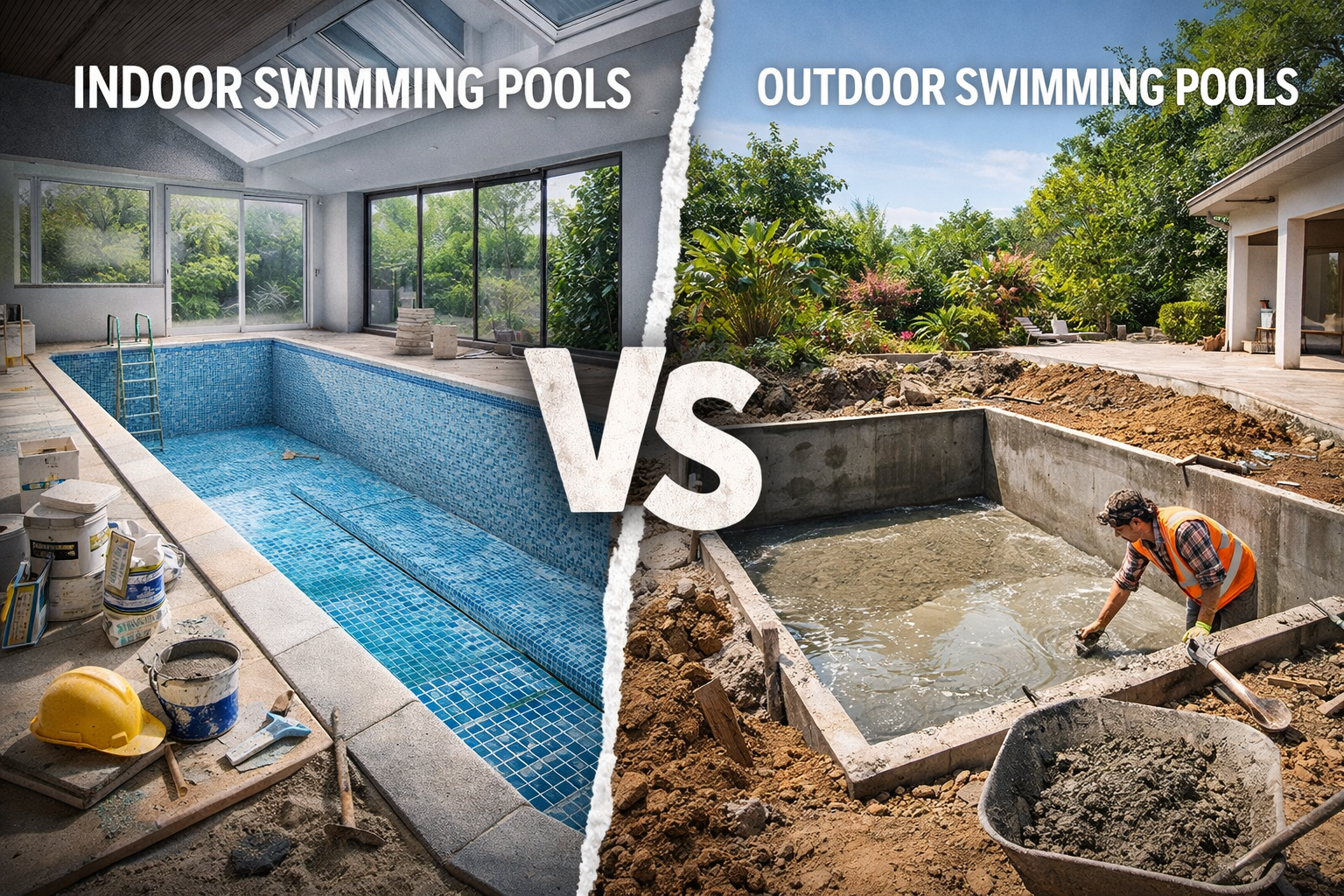
A Comprehensive Comparison on Constructing Indoor vs Outdoor Swimming Pools in Kenya: Pros, Cons & Costs (2026 Guide)
By Egret Swimming Pools | Posted March 2026- Egret Swimming Pools has designed and built swimming pools across Kenya since 2010, working with residential homeowners, hotels, schools, and commercial developers in Nairobi, Mombasa, Kiambu, and beyond.
Introduction
Most people planning a pool in Kenya picture an outdoor pool without thinking twice. Open sky, garden space, warm sunshine, it feels like the natural choice. But a growing number of homeowners, hotel developers, and school administrators are pausing to ask a more deliberate question: would an indoor pool actually serve my needs better? It is a fair question, and the answer depends almost entirely on where your property is located, what you intend to use the pool for, and what budget you are working with. The debate about constructing indoor vs outdoor swimming pools in Kenya is very common and this post will try to answer that.
This guide gives you an honest, Kenya-specific comparison of both options so you can make a confident decision before engaging a contractor.
Quick Answer: Outdoor pools are the most practical and cost-effective choice for most Kenyan properties. Indoor pools make strong sense for swimming academies, highland properties, and commercial facilities that need year-round operation regardless of weather. Your location, purpose, and budget will determine which is right for you.
Indoor vs Outdoor Swimming Pools in Kenya: Which is Which
What Is an Outdoor Swimming Pool? 
An outdoor pool is an open-air pool exposed to natural light and the surrounding environment. It is the default choice across Kenya for both residential and commercial builds. Outdoor pools can include partial shade structures, pergolas, or pool enclosures without being classified as fully indoor.
Egret Swimming Pools has built outdoor pools across Nairobi, Mombasa, Kiambu, Nakuru, and beyond, for homeowners, hotels, schools, and apartment developments. The vast majority of pools built in Kenya are outdoor pools, and for most projects they remain the most sensible option.
What Is an Indoor Swimming Pool?
 An indoor swimming pool is fully enclosed within a building or dedicated structure. The enclosure may be purpose-built alongside a new pool, or integrated into an existing building such as a hotel, gym, or school facility.
Indoor pools in Kenya range from simple enclosed structures with natural ventilation to fully climate-controlled facilities with dehumidification systems. They are more common in commercial settings but are growing in demand among high-end residential clients, particularly in Nairobi’s cooler highland suburbs and premium gated communities.
Building an indoor pool is a more complex engineering project than building an outdoor pool. The enclosure adds structural, mechanical, and ventilation requirements that significantly affect both the construction cost and the ongoing maintenance of the facility.
Indoor vs Outdoor Swimming Pools in Kenya: What Are the Real Differences?
1. Construction Cost
This is the most immediate practical difference between the two options, and it is significant.
An outdoor pool’s construction cost covers the pool shell, waterproofing, tiling, plumbing, filtration equipment, and pool surround. For a standard residential pool in Kenya, this represents the full project scope.
An indoor swimming pool requires all of the above, plus a dedicated enclosure structure, walls, roof, structural foundation, ventilation system, dehumidification equipment, and drainage for condensation. Depending on the size and specification of the enclosure, this can add 60 to 150 percent to the total project cost compared to an equivalent outdoor pool.
For a detailed breakdown of construction costs in Kenya shillings, see our Swimming Pool Construction Cost Guide.
2. Climate Suitability Across Kenya
 Kenya’s climate is more varied than many people outside the country appreciate, and this variation is one of the most important factors in the indoor vs outdoor swimming pool decision.
- Mombasa and the coast: Hot and humid year-round, with average temperatures rarely dropping below 22°C even in the cooler months. Outdoor pools are ideal here, the climate supports comfortable outdoor swimming on virtually every day of the year. An indoor pool in a coastal location would feel unnecessarily enclosed and would require intensive dehumidification to manage the already-humid air inside the enclosure.
- Nairobi and the Central Highlands: Nairobi sits at approximately 1,700 metres above sea level. While daytime temperatures are pleasant year-round, the cold season from June through August sees nighttime temperatures drop to between 10 and 13°C. An unheated outdoor pool during these months is genuinely uncomfortable for most swimmers. Swimming academies, competitive training facilities, and commercial pools in Nairobi that need consistent year-round use benefit meaningfully from indoor enclosures or heating systems.
- Eldoret, Nyeri, Nakuru, and highland areas: These regions experience cooler average temperatures than Nairobi and have cold seasons that limit outdoor pool usability for extended periods. For properties in these areas with serious swimming programmes or commercial operations, an indoor pool is a more practical long-term investment.
3. Maintenance Requirements
 Outdoor pools in Kenya face maintenance challenges driven by the environment: dust, wind-blown debris, insects, and algae growth accelerated by direct sunlight. These are well-understood challenges with established maintenance routines.
Indoor pools face a different and often underestimated challenge: humidity. A pool enclosure traps warm, moisture-laden air. Without a properly designed ventilation and dehumidification system, condensation accumulates on walls, ceilings, and structural elements, leading to mould growth, corrosion of metal fittings, and long-term structural damage to the enclosure itself.
This is not a reason to avoid indoor pools, it is a reason to specify and build them correctly from the outset. Egret includes ventilation system design in every indoor pool project, sized appropriately for the pool volume and the enclosure dimensions.
For more detail on ongoing pool maintenance requirements, see our Pool Maintenance Guide.
4. Privacy and Security
Indoor pools offer an absolute level of privacy that no outdoor pool, regardless of wall height or landscaping, can fully replicate. For high-net-worth residential clients in Karen, Runda, Muthaiga, Gigiri, and Nyali who prioritise complete privacy, an indoor pool or semi-enclosed pool structure is an increasingly popular solution.
For schools, an indoor pool also provides a more controlled and secure environment for children’s swimming lessons, eliminating exposure to weather, reducing distraction, and making supervision more straightforward.
Outdoor pools can achieve good privacy through perimeter walls, landscaping screens, and strategic pool placement, but the level of enclosure is always partial rather than complete.
5. Year-Round Usability
In Nairobi and the highlands, an unheated outdoor pool effectively sits unused for two to three months per year during the cold season. Homeowners who invest in a pool primarily for fitness or daily recreation find this seasonal limitation genuinely frustrating.
An indoor pool, particularly one combined with a heating system, can be used every day of the year regardless of temperature or weather. For competitive swimmers, swimming academies, and hotels marketing themselves as year-round facilities, this continuous availability is not a luxury, it is a core operational requirement.
If you are considering an outdoor pool in a cooler Kenyan location and want to extend its usability through the cold season, a pool heating system is worth evaluating alongside the indoor pool option. We will cover pool heating options in Kenya in detail in a separate guide.
6. Planning and Construction Complexity
 Outdoor pools require standard NCA building approval in Kenya. Egret manages the full permitting process on behalf of clients, and for straightforward residential outdoor pools this process is well-established and predictable.
Indoor pools require additional approvals for the enclosure structure, ventilation system compliance, and in some cases more complex electrical and drainage sign-offs. Construction timelines are longer due to the additional scope of the enclosure works.
For commercial indoor pools, hotel facilities, school swimming centres, gym pools, the approvals process involves multiple authorities and should be factored into project planning from the earliest stage.
Which Pool Type Is Right for Your Project in Kenya?
Choose an outdoor swimming pool if:
- You are building a residential pool in Mombasa, Nairobi, Kiambu, Nakuru, or most other Kenyan locations where the climate supports regular outdoor use
- Your primary purpose is leisure, family recreation, or property enhancement
- You want the most cost-effective pool build for your budget
- You are building a hotel or resort pool in a warm coastal or mid-altitude location
Choose an indoor swimming pool if:
- You are building or upgrading a competitive swimming academy or training facility
- Your property is in a highland area where cold seasons significantly limit outdoor pool use
- You are developing a hotel that needs to market year-round swimming as a confirmed facility
- Complete privacy is a primary requirement for your client
- You are integrating a pool into an existing building structure such as a hotel spa or gym facility
Before You Decide, Have This Conversation With Your Contractor
 The decision between an indoor and outdoor pool is rarely one you should make from a desk. The right answer depends on conditions that only become clear on the actual site, soil drainage, available space, access for construction equipment, prevailing wind direction, and the realistic privacy achievable through alternative means.
Before committing to either option, ask your contractor these questions:
- What are the drainage and soil conditions on this site?
- What ventilation system would be required for an indoor pool here, and what does it add to the project cost?
- What are the NCA permitting requirements for an indoor pool in this county?
- What is the realistic construction timeline for each option on this specific site?
- What will the long-term maintenance cost difference be between the two options?
These are exactly the questions Egret answers during a free site consultation. We have built both indoor and outdoor pools across Kenya and will give you a transparent comparison for your specific project, without pushing you toward the option that is easier for us.
Ready to Find the Right Pool for Your Property? Let’s Talk.
Deciding between an indoor or outdoor pool in Kenya? Compare costs, climate suitability, maintenance, and use cases to choose the right pool for your property. Egret Swimming Pools offers free consultations and site assessments across Kenya. Whether you are considering an indoor or outdoor pool, we will visit your property, assess the site, and give you an honest recommendation based on your goals and budget, not on a standard template.
- Call Us Today: +254726545148
- WhatsApp: You can send us a WhatsApp message at +254726545148 and we will reply as soon as possible.
- Email: info@egretswimmingpools.co.ke | egreteswimmingpools@gmail.com
- Visit Us: We are located at Kihunguro behind shell petrol station Kihunguro Thika road. See Google map location.
- Comment form: You can leave a comment in the comment form below this post and we will respond to you shortly.
- Contact us form: You can fill out the contact us form here.
We’ll guide you through every step—from design and permits to excavation, installation, and finishing.
Frequently Asked Questions- Indoor vs Outdoor Pools in Kenya
- Is it worth building an indoor pool in Nairobi? For a competitive swimming academy or a hotel marketing year-round facilities, yes. For a standard residential pool, an outdoor pool with a heating system is usually more cost-effective. The answer depends on your specific purpose and how often you intend to use the pool during Nairobi’s cold season.
- How much more expensive is an indoor pool compared to an outdoor pool in Kenya? The pool shell itself costs the same. The enclosure structure, ventilation system, and additional civil works typically add 60 to 150 percent to the total project cost. Contact Egret for a site-specific comparative quote. See our Swimming Pool Cost Guide for full pricing context.
- Can I add an enclosure to my existing outdoor pool in Kenya? Yes, retrofitting an enclosure over an existing pool is possible, though it requires a structural assessment of the existing pool and surround. Egret can evaluate existing pools for enclosure retrofits as part of our upgrade and renovation services.
- Do indoor pools require special ventilation in Kenya’s climate? Yes, without exception. All indoor pools require a purpose-designed ventilation and dehumidification system to prevent condensation, mould, and structural damage to the enclosure. This is a non-negotiable element of every Egret indoor pool project specification.
- Which type of pool is better for a hotel in Kenya? Hotels at coastal and mid-altitude locations generally perform best with outdoor pools. Hotels in cooler highland areas, or those targeting premium year-round occupancy, benefit from indoor pools or heated outdoor pools. See our hotel swimming pool construction services for more details.


