
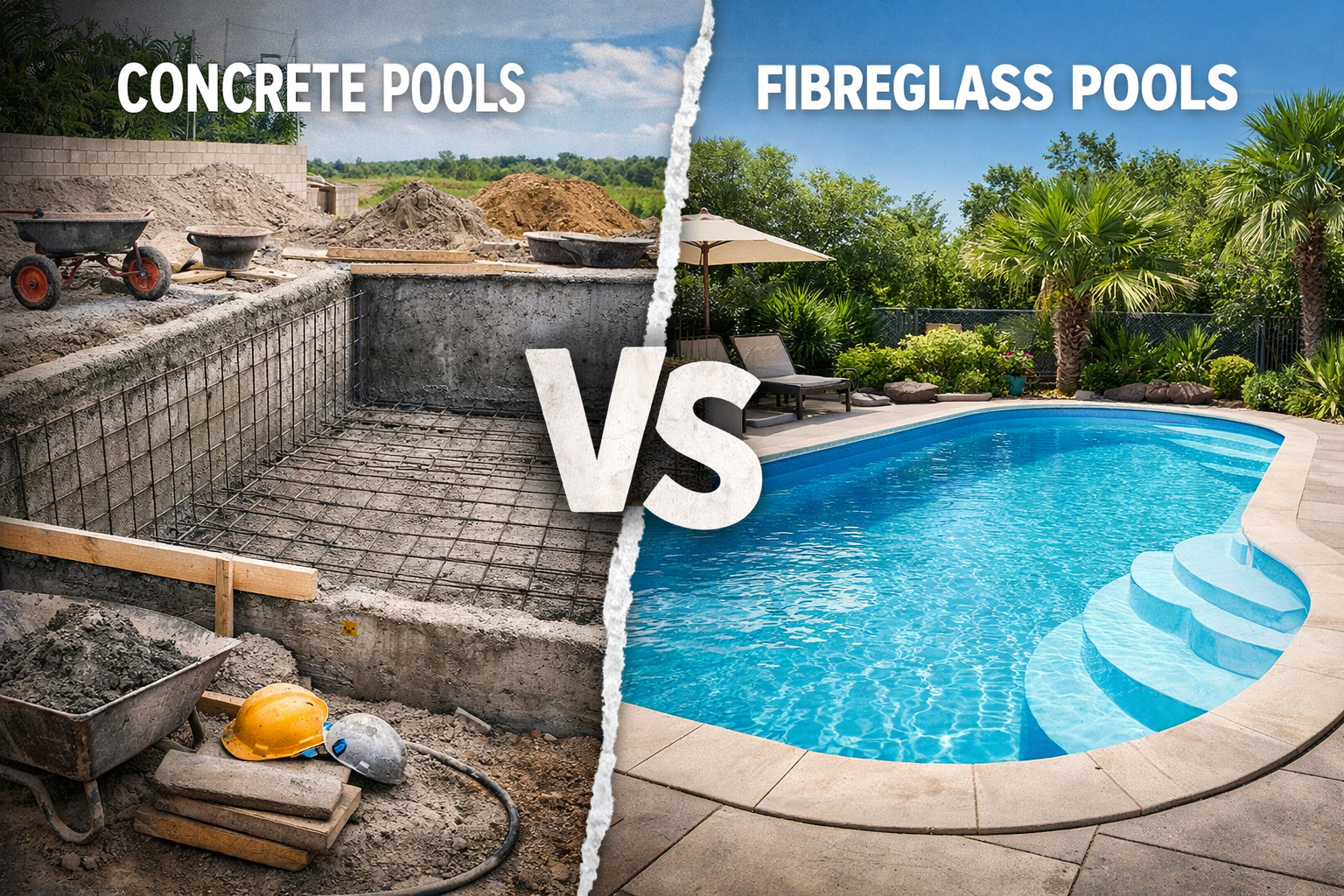
Concrete vs Fibreglass Pools in Kenya: Which Is Better for You? (a 2026 Guide)
When you have decided to build a swimming pool in Kenya, the excitement quickly gives way to a very practical question: what type of pool should you actually build? Of all the decisions that go into a pool project, this one between concrete vs fibreglass pools in Kenya has the most far-reaching consequences for your budget, your timeline, your maintenance routine, and the long-term performance of the pool.
At Egret Swimming Pools, it is one of the first questions we answer for every new client. And the honest answer is that both options are excellent when chosen for the right reasons on the right project. The wrong choice, however, can mean a pool that costs more to maintain than it should, takes longer to build than your timeline allows, or simply does not perform the way you imagined.
This guide gives you the full picture costs, durability, maintenance, design flexibility, and suitability for Kenya’s specific conditions so that by the time you finish reading, you will know which pool type makes sense for your property, your lifestyle, and your budget.
Quick Answer: Concrete pools offer more design flexibility and are better suited for large commercial projects, while fibreglass pools are faster to install, lower maintenance, and increasingly popular for residential builds in Kenya. The right choice depends on your budget, site conditions, and long-term goals.
What Is a Concrete Swimming Pool?
 A concrete swimming pool is built entirely on-site, from the ground up. The process begins with excavation, followed by the installation of a steel rebar framework that forms the structural skeleton of the pool. Concrete, either poured into formwork or pneumatically sprayed using the gunite or shotcrete method is then applied over the steel framework to create the shell. Once cured, the interior surface is waterproofed, plastered, and finished with tiles or an aggregate coating.
Concrete is the traditional and most widely used pool construction method in Kenya and across East Africa. It has been the default choice for decades because of its flexibility. A concrete pool can be built in virtually any shape, size, or depth, on almost any site. Egret Swimming Pools has built hundreds of concrete pools across Kenya, from compact residential pools in Nairobi’s suburbs to large commercial pools for hotels and schools.
The trade-off for that flexibility is time and long-term maintenance. Concrete pools take longer to build and require more ongoing chemical and physical maintenance than fibreglass.
What Is a Fibreglass Swimming Pool?
 A fibreglass pool is manufactured off-site as a single pre-formed shell, made from layers of woven fibreglass matting saturated in resin and finished with a smooth gel-coat surface. The shell is manufactured in a controlled factory environment, then transported to the client’s site and installed into a prepared excavation.
Fibreglass pools have been growing steadily in popularity in Kenya, particularly for residential builds, because of their speed of installation and low long-term maintenance requirements. The smooth, non-porous gel-coat surface does not support algae growth in the way that porous concrete plaster does. Meaning fewer chemicals, less scrubbing, and lower running costs over the life of the pool.
The trade-off is design flexibility. Fibreglass shells come in manufacturer-determined shapes and sizes. If you want a custom shape, an unusually large pool, or a specific design feature like a vanishing edge, fibreglass is not the right choice.
Concrete vs Fibreglass Pools in Kenya: A Full Comparison
1. Construction Cost
Cost is almost always the first factor clients want to understand. And the honest answer is that it is more nuanced than a simple “one costs more than the other.”
For a standard residential pool in the 4m x 8m to 6m x 12m range, the total project cost for both options is often closer than clients expect. Concrete pools have higher labour costs; they are built from scratch on-site over many weeks, requiring skilled tradespeople at every stage. Fibreglass shells have a higher upfront material cost since the shell is a manufactured product, but the shorter installation time reduces labour costs significantly.
For larger pools; hotel pools, school pools, pools over 8m x 16m, concrete becomes the only practical option, and the cost comparison becomes irrelevant. For compact to mid-size residential pools, fibreglass can offer comparable or even lower total project cost depending on the specific design.
For a detailed breakdown of swimming pool construction costs in Kenya in KSh, see our Swimming Pool Construction Cost Guide.
2. Installation Time
This is where fibreglass has a clear and meaningful advantage for most residential clients.
A standard concrete pool in Kenya takes between 8 and 12 weeks from groundbreaking to completion, and that is without accounting for the design and permitting phase that precedes construction. A fibreglass pool can be installed in 3 to 5 weeks from excavation to water filling.
The reason for the difference is straightforward: a concrete pool is built from scratch at every stage. Concrete must be mixed, applied, and cured. A process that cannot be rushed without compromising structural integrity. Plastering, tiling, and coping all follow in sequence. A fibreglass pool bypasses all of that; the shell arrives ready-made, the installation is essentially a precision excavation and connection job, and the finishing work is concentrated primarily on the pool surround.
For a hotel with an opening date, a school with a term calendar, or a homeowner who wants to swim by December, this timeline difference is not a minor detail, it is a decisive factor. Always build your target completion date into your contractor conversation from day one.
3. Design Flexibility
If design flexibility is your priority, concrete wins without qualification.
Concrete pools can be built in any shape, any size, and any depth configuration. L-shaped pools, kidney-shaped pools, infinity pools with vanishing edges, beach-entry pools with a gradual zero-depth slope, pools with integrated spa sections, all require concrete construction. Custom mosaic tile work, bespoke water features, and irregular freeform shapes that mirror the contours of a natural landscape are all within the scope of a well-designed concrete pool.
Fibreglass pools are constrained by the manufacturer’s available range of shapes and sizes. You choose from an existing catalogue of shell designs rather than designing from a blank canvas. For clients with a specific vision that falls outside standard rectangular or oval shapes, or for any commercial pool that needs to meet capacity requirements, fibreglass is simply not the right tool.
There is one important nuance: for clients who want a standard rectangular or oval residential pool, this constraint is largely irrelevant. The available fibreglass shell range covers the most popular residential pool shapes comprehensively, and for straightforward builds the design limitation is not a practical issue.
4. Maintenance Requirements
This is arguably the most important long-term cost difference between the two pool types, and it consistently surprises clients who focus only on the upfront construction cost.
Fibreglass pools are significantly easier and cheaper to maintain than concrete pools. The reason lies in the surface. The smooth, non-porous gel-coat finish of a fibreglass pool does not support algae attachment in the way that concrete plaster does. Algae spores need a rough, porous surface to anchor themselves, and fibreglass simply does not provide that. The result is that fibreglass pools require fewer chemicals, less frequent scrubbing, and rarely need the acid washing that concrete pools periodically require to restore their surface.
Concrete pools, by contrast, have a porous plaster surface that is chemically active. They require higher chlorine levels to maintain water safety, more frequent pH balancing, and regular physical brushing of the pool walls and floor to prevent algae build-up. Over 10 to 15 years, the cost difference in chemicals and maintenance labour between the two pool types is substantial.
In Kenya’s climate, particularly in Nairobi and Mombasa where heat and sunlight accelerate algae growth, this maintenance differential is more pronounced than in cooler climates.
5. Durability and Lifespan in Kenyan Conditions
Both pool types, when properly built, are built to last decades. But the way they age, and the conditions they age best in, differs in ways that are particularly relevant to Kenya.
Kenya’s soil conditions vary significantly by region. Nairobi and much of the Central Highlands sit on expansive black cotton soil, a clay-heavy soil that swells when wet and contracts when dry, causing ground movement throughout the year. This ground movement is hard on rigid structures, and concrete pool shells, which are inflexible by nature, can develop hairline cracks over time in areas with significant black cotton soil presence. These cracks are usually cosmetic rather than structural, but they require periodic repair and can become a source of water loss if left unaddressed.
Fibreglass shells have a degree of inherent flexibility that allows them to absorb minor ground movement without cracking. For properties on expansive soils in Nairobi, Kiambu, and surrounding areas, this is a genuine advantage that often influences Egret’s recommendation toward fibreglass for residential builds on particularly problematic ground.
In terms of lifespan, a concrete pool’s plaster surface typically needs resurfacing every 10 to 15 years, a significant but not unexpected maintenance cost. A fibreglass gel-coat in good condition can last 20 to 25 years before any resurfacing is required, and many never need it at all with proper care.
6. Chemical and Water Use
Fibreglass pools require fewer chemicals to maintain safe water quality, a direct consequence of the non-porous surface described above. This reduces both the ongoing cost of chemicals and the volume of chemical products that need to be purchased, stored, and handled.
For properties that fill their pool from a borehole, which is very common in Kenya, this chemical efficiency is particularly valuable. Borehole water in many parts of Kenya is high in minerals, particularly calcium, which already creates chemical management challenges. A fibreglass pool’s lower base chemical demand gives the pool owner more headroom before water chemistry becomes difficult to manage.
The reduced chemical requirement also has a modest environmental benefit, fewer chemicals manufactured, transported, and introduced into the pool and eventually the environment through backwashing.
7. Resale Value and Aesthetics
Both pool types add meaningful property value in Kenya when properly maintained and well-designed. The difference in resale impact is less about the construction method and more about the overall design quality and finish.
Concrete pools offer the widest range of aesthetic possibilities, custom tile choices, mosaics, freeform shapes, and bespoke features all contribute to a pool that can be a true architectural statement. For luxury residential properties in Karen, Runda, Muthaiga, and high-end coastal properties in Mombasa and Diani, a premium concrete pool with exceptional finish quality is often the right investment.
Fibreglass pools offer a clean, modern aesthetic that suits contemporary architecture well. The range of available finishes has improved significantly and the best fibreglass gel-coats look genuinely premium. For most residential builds, the aesthetic result is excellent and the difference from a well-finished concrete pool is not significant.
Concrete vs Fibreglass Pools in Kenya- So, Which Pool Should You Choose in Kenya?
After laying out all the evidence, here is the clear and honest framework Egret uses to guide clients:
Choose a concrete pool if:
- You want a custom shape, large pool, or a specific design feature such as a vanishing edge, beach entry, or integrated spa
- You are building a commercial, hotel, or school pool where size or capacity requirements exceed what fibreglass shells offer
- Your project requires a pool larger than approximately 8m x 16m
- You want maximum design flexibility and are prepared to invest more time and resources in long-term maintenance
- Your site has stable ground conditions without significant clay soil movement
Choose a fibreglass pool if:
- You are building a standard residential pool and want a faster installation timeline
- You want lower long-term chemical and maintenance costs
- Your property is in an area with expansive clay soils, common in Nairobi, Kiambu, and the Central Highlands
- You have a fixed target date that makes a 10–12 week concrete build difficult to accommodate
- You want the lowest practical ongoing cost of pool ownership over 20 or more years
Concrete vs Fibreglass Pools in Kenya: The Most Important Factor Is Who Builds Your Pool
Here is something that every prospective pool owner in Kenya should understand: the quality of the contractor who builds your pool matters more than the material they build it from.
A poorly built fibreglass pool, installed without proper base preparation, or with incompatible fittings that corrode in the water, will underperform a well-built concrete pool every time. And a concrete pool built with substandard materials, inadequate waterproofing, or insufficient steel will develop cracks and leaks regardless of how well the plaster looks on day one.
The factors that determine whether your pool performs beautifully for 25 years or starts causing problems in year three are the ones you cannot see: the concrete mix specification, the rebar installation, the waterproofing application, the quality of the fittings, and the precision of the plumbing. These are the decisions that separate experienced, reputable pool contractors from the alternatives.
At Egret Swimming Pools, every project begins with a site visit to assess your ground conditions, drainage, access, and any site-specific constraints that should influence the pool type recommendation. We specify the right pool for your site, not the easiest pool for us to build. And we back every project with a structural warranty because we build pools we are confident in.
Ready to Build Your Pool in Kenya? Talk to Egret Swimming Pools.
Whether you are leaning toward concrete or fibreglass, or you are still not sure which is right for your specific property, Egret Swimming Pools is ready to help. We build both pool types to world-class standards across Kenya, and our free site assessment will give you a clear, honest recommendation based on your site, your goals, and your budget.
Call or WhatsApp us on +254 726 545 148, email us at info@egretswimmingpools.co.ke, or visit our Contact page to get the conversation started.
Frequently Asked Questions, Concrete vs Fibreglass Pools in Kenya
- Is fibreglass or concrete cheaper to build in Kenya? For standard residential pool sizes, fibreglass and concrete pools are often comparable in total project cost, fibreglass shells cost more as a material but save on labour due to shorter installation time. For large or custom pools, concrete is the only practical option. The best approach is to get a detailed quote for both options on your specific project. See our full swimming pool cost guide for detailed pricing information.
- Can fibreglass pools crack in Nairobi’s climate? Fibreglass pools are actually more resistant to cracking than concrete pools in areas with expansive clay or black cotton soils, which are common across Nairobi and Kiambu County. Their inherent flexibility allows the shell to absorb minor ground movement that would cause hairline cracks in a rigid concrete shell.
- How long does it take to install a fibreglass pool in Kenya? A fibreglass pool can typically be installed in 3 to 5 weeks from the start of excavation to water filling. The total project timeline including design and permits is usually 6 to 10 weeks. Concrete pools take 8 to 12 weeks for construction alone. See our complete guide to pool construction timelines in Kenya for a full stage-by-stage breakdown.
- Which pool type is better for a hotel or school in Kenya? Concrete pools are almost always the right choice for hotels and schools. The size requirements of commercial pools typically exceed the dimensions available in fibreglass shell ranges, and the design flexibility of concrete allows pools to be tailored to specific capacity, safety, and aesthetic requirements. Egret has built pools for hotels and schools across Kenya, contact us to discuss your commercial project.
- Do fibreglass pools work with borehole water in Kenya? Yes, and fibreglass pools are actually well-suited to borehole water for an important reason. Their lower chemical demand means the mineral content of borehole water is easier to manage. Concrete pools require higher chemical doses that can interact more aggressively with high-mineral borehole water. That said, a water quality test is always advisable before commissioning any pool system on borehole water.
Egret Swimming Pools builds world-class concrete and fibreglass swimming pools across Kenya. Based in Kihunguro, Ruiru, Kiambu County, we serve residential and commercial clients throughout Nairobi, Mombasa, Kiambu, Nakuru, Kisumu, and beyond.
Call us on +254 726 545 148


